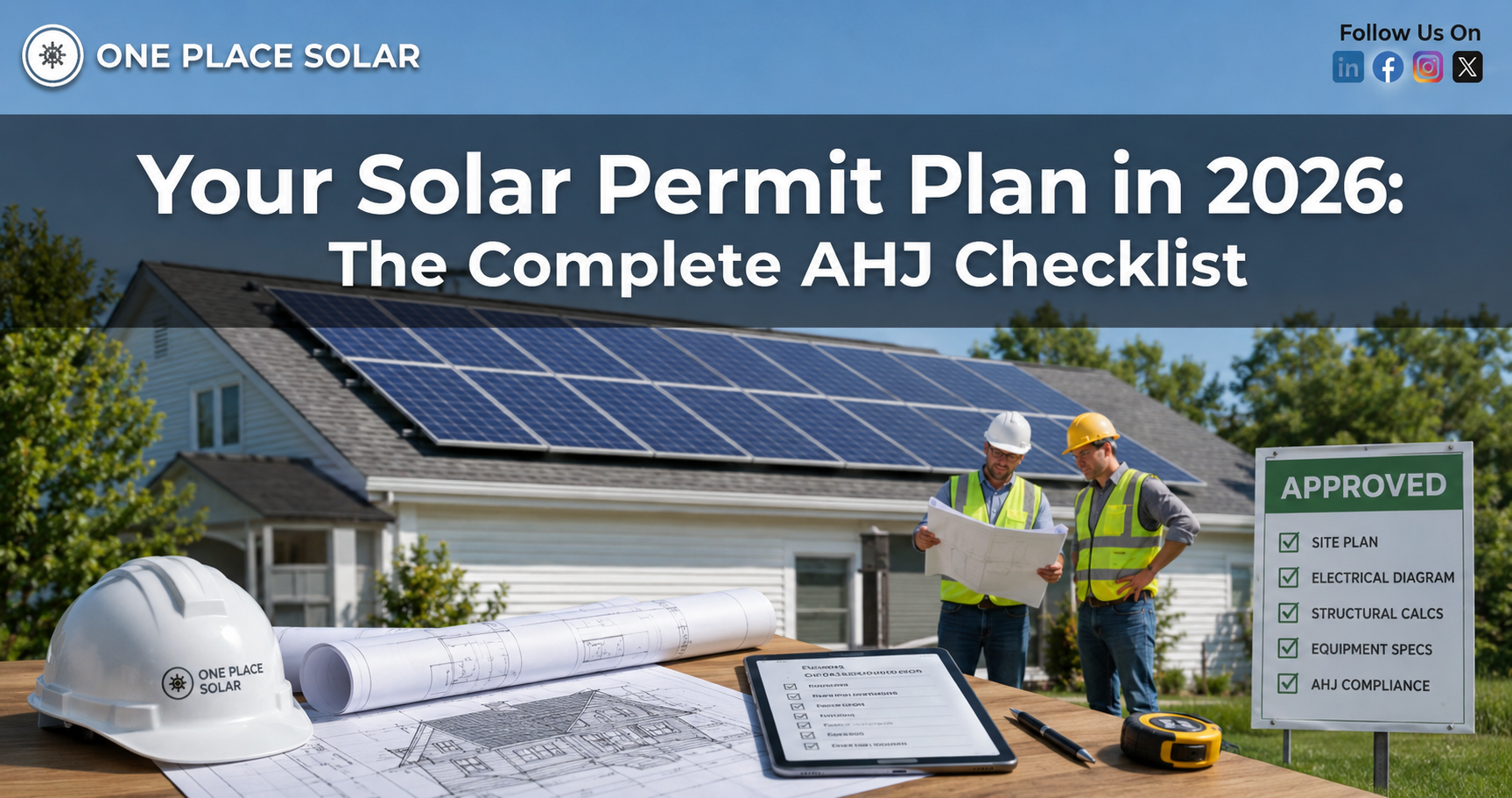
Your Solar Permit Plan in 2026: The Complete AHJ Checklist
Every document, drawing, and 2026-specific update your solar permit plan needs to clear AHJ review on the first submission — no correction cycles, no rescheduled crews.

What is a solar permit plan?
A solar permit plan — also called a solar permit plan set or solar plan set — is the complete package of drawings, calculations, and documentation that an installer or EPC submits to the Authority Having Jurisdiction (AHJ) before a solar installation can begin. The AHJ is the local building or electrical department responsible for issuing the permit and scheduling inspections.
A complete solar permit plan typically includes a cover sheet with code references, a site plan, a roof layout drawing, a single-line electrical diagram, structural calculations, equipment data sheets, and a labeling schedule. Commercial projects also require three-line diagrams and PE-stamped engineering packages. Every jurisdiction has its own requirements, but these components form the national baseline established under NFPA 70 (NEC) Article 690.
Getting your solar permit plan right the first time matters more than it used to. AHJ reviewers in 2026 are working from standardized digital checklists, NEC adoption is shifting faster than many installer templates can keep up, and battery storage — with its own documentation burden — has moved from edge case to standard scope. Each rejection costs an estimated $2,000–$5,000 in revision fees and crew rescheduling alone, before accounting for timeline delays that can affect ITC eligibility on commercial projects. If you want to see what a finished package looks like before building yours, browse our sample solar permit plan.
Cover Sheet & General Notes
The cover sheet is the first page every AHJ reviewer opens. A well-structured solar permit plan leads with a title block on every sheet — project address, APN, designer name, issue date, and revision number. The cover sheet also carries a general notes section that explicitly states the applicable code editions: NEC 2023 or NEC 2026 depending on jurisdiction, IBC 2021, IRC 2021, and any local amendments. You can cross-reference NFPA’s official NEC adoption map to confirm which edition your AHJ enforces.
An incomplete title block is one of the five most common reasons a solar permit plan is returned before review even begins. AHJ reviewers are required to log this information against permit records. If it isn’t present, the submittal is sent back — regardless of how complete the technical drawings behind it are.
One 2026-specific addition: many utilities — especially in California, Texas, and New England — now require the interconnection application number on the cover sheet before AHJ approval is granted. Build this into your cover sheet template from the start. Our residential solar permit plan service handles this automatically for every state we cover.
Cover Sheet Checklist
Site Plan
The site plan is the AHJ reviewer’s first visual reference for the project as a whole. It establishes property boundaries, structure footprint, service equipment location, and array placement relative to the property. Reviewers use this sheet to confirm fire setbacks, access pathways, and working space clearances — cross-referencing it against satellite imagery and GIS records.
Fire setback requirements for residential rooftop systems follow the International Fire Code (IFC) — typically 3 feet from ridges and hips, 18 inches from eaves and valleys, and a minimum 3-foot-wide access pathway. These must be explicitly dimensioned, not assumed from layout. You can review the current IFC requirements in the IFC 2021 published by the ICC.
A solar permit plan that shows inaccurate property boundaries, omits roof structures, or leaves fire setback dimensions unlabeled will be flagged on this page before a reviewer reaches the electrical drawings. See our guide on fire setback requirements by state for a jurisdiction-by-jurisdiction breakdown.

Site Plan Checklist
Roof Layout Drawing
The roof layout drawing is the sheet most AHJ reviewers focus on most closely. In a solar permit plan, this drawing must be to scale and clearly show panel placement, row spacing, module count, and every roof obstruction — HVAC units, vents, skylights, chimneys — with setback dimensions labeled.
Reviewers cross-check this sheet against both the structural documents and the mounting specifications. If the module count or spacing in the roof layout differs from the load assumptions in the structural calculations anywhere in the solar permit plan, the package is flagged and held for load verification. Consistency across sheets isn’t a formality — it’s how reviewers validate the structural case.
Roof Layout Checklist
Single-Line Diagram
The single-line diagram (SLD) is the electrical core of any solar permit plan. It must trace the complete circuit path from the PV array through string wiring, combiner boxes where applicable, inverters, AC and DC disconnects, production meters, and the point of utility interconnection. Every component must carry its manufacturer name, model number, and relevant electrical ratings.
NEC 690.8 violations account for an estimated 30–40% of solar permit rejections nationwide. The most common miss: applying the 125% continuous current multiplier but omitting ambient temperature correction factors and conduit fill derating. The entire derating chain must be documented directly on the diagram — reviewers should not be required to infer it, and in 2026 most won’t. The full calculation methodology is codified in NEC Article 690, which you can access through NFPA’s free online viewer.
If your solar permit plan includes battery storage, the SLD must also reference NEC Article 706 alongside NEC 690. A BESS layout that shows only NEC 690 citations will trigger corrections in virtually every jurisdiction that reviews battery packages carefully. Read our full breakdown of battery storage permit requirements for what the Article 706 integration looks like in practice.
Single-Line Diagram Checklist
“Every equipment callout in a solar permit plan’s electrical sheet must match the cut sheet exactly. A single model number discrepancy between the one-line and the spec sheet triggers a correction notice — every time.”
Multi-state AHJ review pattern, compiled across residential and commercial submittalsStructural Documentation

Structural documents are the most commonly missing component in both residential and commercial solar permit plans. At minimum, your package must include roof load calculations showing the additional dead load from racking and modules, wind uplift per ASCE 7, snow load where applicable, and roof material type and condition.
AHJs are requiring PE-stamped structural calculations with increasing frequency in 2026 — including on projects that would have passed without them just a few years ago. This is especially true in wind and seismic zones. For commercial projects, stamped calculations are effectively universal. For residential systems in Florida, California, and high-load states, confirm requirements before assuming a residential exemption applies. Our PE-stamped solar permit plan service covers all 50 states with licensed engineers in every major market.
The National Renewable Energy Laboratory’s (NREL) solar permitting research consistently identifies incomplete structural documentation as a leading cause of residential permit delays — averaging 2–3 additional weeks per project when corrections are required.
Structural Checklist
Equipment Cut Sheets & Specifications
Every equipment callout in your solar permit plan must be supported by a manufacturer data sheet, and every model number, voltage rating, and current capacity on the data sheet must match the drawings exactly. Mismatches — particularly between the inverter model on the single-line diagram and the cut sheet — are one of the most common triggers for a correction notice.
In 2026, two additions are now expected in many markets: battery storage cut sheets must include NEC 706 cross-references alongside NEC 690 citations, and FEOC compliance documentation is required for battery equipment in California, Texas, and Florida AHJs. For commercial projects pursuing ITC incentives, FEOC documentation is not optional — as of January 2026, 40% non-FEOC sourcing by manufactured product value is a statutory requirement. The Department of Energy’s FEOC guidance page is the authoritative reference for which manufacturers and components qualify.
For a full list of CEC-listed inverters and modules accepted across most AHJ markets, the California Energy Commission’s equipment database is the most widely referenced tool in the industry — even for non-California projects.
Equipment Documentation Checklist
Labeling Schedule
A solar permit plan’s labeling schedule documents every NEC-required placard, rapid shutdown label, warning sign, and shutdown instruction — with exact wording, format specifications, and placement notes for each required location. In 2026, most AHJs follow the SolarAPP+ platform or a local equivalent, which means label placements and call-outs need to match what inspectors see in their mobile review tools. Missing or outdated labeling language forces corrections because reviewers must verify current-cycle compliance before issuing approval.
For a complete reference on required solar label wording and placement, the NEC 690.31, 690.53, and 690.56 sections govern the majority of required signage. Our solar labeling guide maps every required label to its NEC subsection and shows example placements for all seven standard locations.
Labeling Schedule Checklist
NEC 2026 Changes That Affect Your Solar Permit Plan
If your solar permit plan templates haven’t been reviewed against NEC 2026, they are creating compliance risk on every submittal in any market that has adopted the new code cycle. These are the specific changes that affect drawings at the design level — not just boilerplate notes on the cover sheet. The full NEC 2026 text is available through NFPA’s official code viewer.
| NEC 2026 Change | What It Affects in Your Solar Permit Plan | Required Update |
|---|---|---|
| Section 690.4(G) — new rounding rule | PV system calculations | Update calculation templates to use the 2026 rounding method |
| NEC 690.8 — updated Isc calculation requirements | Conductor sizing throughout the SLD | Document full derating chain: ambient correction and conduit fill derating must both appear on diagram |
| NEC 690.12 — refined rapid shutdown requirements | Rapid shutdown label wording and equipment specification | Update label wording; confirm equipment model cites the correct 2026 subsection |
| Updated MLPE documentation requirements | Microinverter and DC optimizer systems | Add module-level power electronics callouts to SLD where applicable |
| Expanded BESS provisions (NEC Article 706) | Any solar permit plan including battery storage | Add NEC 706 cross-references to battery SLD elements; separate battery layout diagram required |
| Updated AFCI provisions | Residential PV systems | Confirm AFCI device spec meets 2026 requirements for the array configuration |
State-Specific & AHJ-Specific Requirements
A solar permit plan built to national NEC standards is the baseline, not the finish line. Before any submittal, confirm these five things directly with the AHJ. For a state-by-state lookup of NEC adoption status, the NFPA NEC adoption tracker is updated regularly and is the most reliable public reference.
-
1Which NEC edition the jurisdiction enforces California enforces NEC 2026. Most North Carolina AHJs still use NEC 2020 with state amendments. This must be confirmed — not assumed — on every solar permit plan in every market you operate in.
-
2PE stamp format — wet ink or certified digital seal Texas has no statewide PE stamp framework; requirements vary city by city. Florida requires a PE stamp on virtually every installation. Submitting a digital seal to an AHJ that requires wet ink holds up an otherwise complete solar permit plan by weeks. See our PE stamp requirements by state guide for a complete breakdown.
-
3SolarAPP+ eligibility Florida, Texas, and Arizona process many residential solar permit plans in one to three business days through SolarAPP+. If your AHJ uses the platform, your plan set must comply with its specific requirements — not just general AHJ standards. The two are not the same.
-
4Utility interconnection documentation requirements Many utilities in California, Texas, and New England now require the interconnection application number on the solar permit plan before AHJ approval. Confirm what your utility requires before the cover sheet is finalized.
-
5State code overlays beyond base NEC California adds CEC Title 24 requirements. Massachusetts uses 527 CMR. Florida operates under the Florida Building Code. Georgia requires the plan set to reference NEC 2023 with 2026 Georgia Amendments on the cover sheet. Templates built for one state will create gaps in another. Our state-by-state solar permitting requirements page keeps this information current.
Official Resources for Solar Permit Plan Compliance
Solar Permit Plan: Common Questions
Get a Solar Permit Plan That Passes First Time
OnePlaceSolar delivers AHJ-ready solar permit plans across all 50 states — NEC 2026 compliant, PE-stamped where required, and built to your specific jurisdiction’s requirements. Residential turnaround in 15–24 hours.
Request a Solar Permit Plan View Sample PackageLeave a Reply
You must be logged in to post a comment.