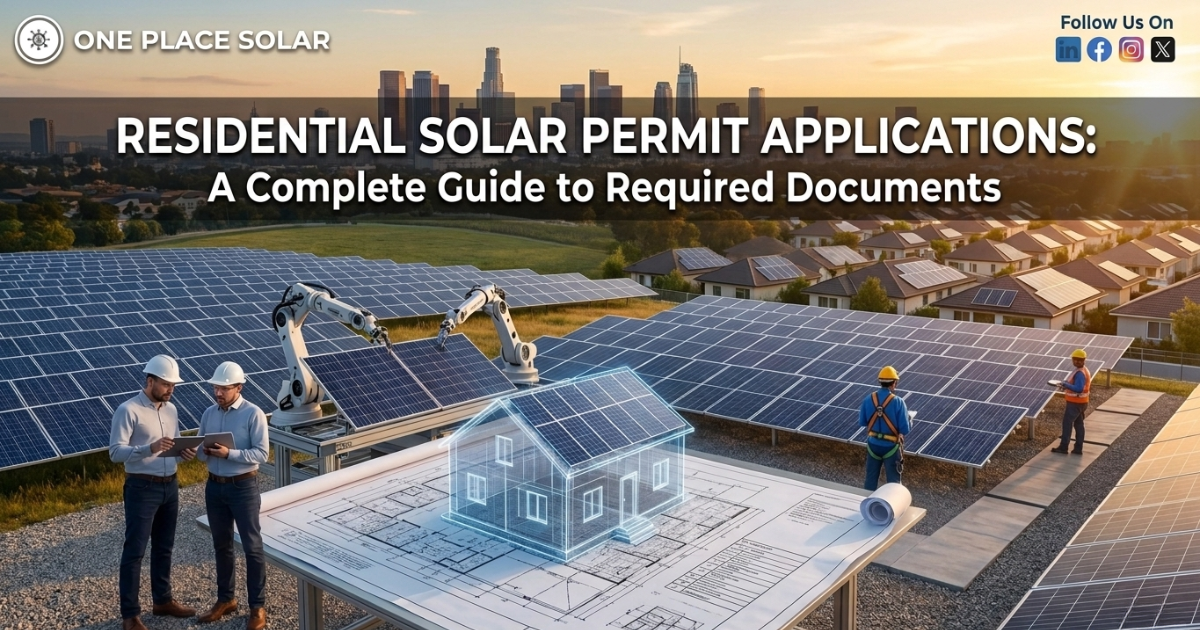
Residential Solar Permit Applications: A Complete Guide to Required Documents
Going solar is one of the smartest investments a homeowner can make — but before a single panel gets installed, every residential solar permit application must clear a critical review process. Navigating this process without the right documentation leads to delays, re-submissions, and unnecessary costs. This guide walks you through every document you need, in the order you need it.
- Why Residential Solar Permit Applications Are Required
- Core Documents for Every Residential Solar Permit Application
- Electrical & System Design Documents
- Structural & Rooftop Documents
- Utility & Interconnection Documents
- AHJ Variations: What Changes by Jurisdiction
- Common Residential Solar Permit Application Rejection Reasons
- Residential Solar Permit Application — Final Submission Checklist
- How One Place Solar Streamlines the Process
Why Residential Solar Permit Applications Are Required
In virtually every city, county, and municipality across the United States, Canada, and the UK, residential solar permit applications are required before work can begin. Permits exist to protect homeowners, neighbors, and utility grid infrastructure by ensuring that solar systems meet established electrical, structural, and fire safety codes.
Skipping or rushing the residential solar permit application process can result in system shutdowns, fines, failed utility interconnection, and even the forced removal of a completed installation. Systems installed without proper permits may not qualify for net metering agreements or federal and state tax incentives.
Most jurisdictions require permits for both grid-tied and off-grid residential solar systems, as well as for battery energy storage systems (BESS) added to existing installations.
Core Documents for Every Residential Solar Permit Application
Regardless of jurisdiction, the following documents form the non-negotiable foundation of any residential solar permit application. Submitting with these incomplete or inaccurate is the single most common cause of first-round rejections.
Permit Application Form
The official AHJ form filled out with property address, owner details, contractor license number, and system description.
Site Plan
A scaled drawing showing the property layout, roof orientation, panel placement zones, and setback distances from edges and obstructions.
Electrical Single-Line Diagram
A schematic showing all electrical components, wire sizes, conduit types, grounding, and interconnection to the utility meter or main panel.
Equipment Specifications
Manufacturer spec sheets (cut sheets) for every major component: modules, inverters, optimizers, and mounting hardware.
Structural / Mounting Plan
Roof attachment details showing rafter span, attachment points, lag bolt specifications, and load path calculations.
Contractor License & Insurance
Proof of the installer’s active contractor license and general liability insurance certificate for the jurisdiction of the project.
Electrical & System Design Documents
The electrical documentation is typically the most scrutinized part of any residential solar permit application. Plan reviewers — and increasingly, automated AHJ review systems — check for compliance with the current edition of the National Electrical Code (NEC) and any local amendments.
Single-Line Diagram (SLD)
Your SLD must include conductor sizing, overcurrent protection (OCPD) ratings, disconnects, grounding electrode conductors, and the point of common coupling (PCC) with the grid. For battery storage systems, the SLD should show the battery management system (BMS) interface, automatic transfer switch (ATS) if applicable, and all critical load panels.
Three-Line Diagram (Where Required)
Larger residential systems (typically above 10 kW) and systems in California, New York, or other high-scrutiny states may require a three-line electrical diagram showing all three phases, in addition to a standard SLD.
Load Calculations
If the solar system will require a service panel upgrade, busbar replacement, or meter socket change, load calculations must be submitted demonstrating that the existing or upgraded service panel can safely accommodate the solar system’s output under worst-case conditions.
As more jurisdictions adopt NEC 2020 and NEC 2023, your electrical package must reflect updated rapid shutdown (RSD) requirements under Article 690.12. Always confirm which NEC edition your AHJ has adopted before finalizing your drawings.
Structural & Rooftop Documents
AHJs want to be certain that the additional weight and wind load of solar panels will not compromise the structural integrity of the home’s roof and framing. These documents address exactly that concern.
-
01Roof Framing Plan
An overhead drawing of the existing roof structure, including rafter or truss spacing, size, span, and species/grade of lumber. This is cross-referenced with your mounting attachment points.
-
02Structural Calculations
Engineering calculations demonstrating that the roof can support the dead load of the panels plus snow load, wind uplift, and seismic forces applicable to the property’s geographic location.
-
03Mounting System Details
Manufacturer-provided installation details for the racking system (e.g., IronRidge, Unirac, K2 Systems), including lag bolt diameter, embedment depth, and flashing specifications.
-
04PE Stamped Engineering Letter
A Professional Engineer (PE) licensed in the project state must stamp and sign the structural calculations confirming code compliance. This is a hard requirement in most US states and jurisdictions.
-
05Roof Pitch & Material Documentation
Documentation of existing roof pitch, material type (asphalt shingles, tile, metal, flat TPO), and condition — sometimes requiring a photo report or roofing contractor sign-off.
Utility & Interconnection Documents
Beyond the AHJ building permit, grid-tied solar systems require a separate approval from the local utility — the interconnection agreement. These documents are submitted to the utility, not the city or county, though some AHJs require proof of a submitted interconnection application before issuing a building permit.
| Document | Submitted To | Status |
|---|---|---|
| Net Energy Metering (NEM) Application | Utility Company | Required |
| Interconnection Agreement Form | Utility Company | Required |
| Anti-Islanding Certification | Utility / AHJ | Required |
| Utility-Specific SLD (UL 1741-SA) | Utility Company | Sometimes Required |
| Permission to Operate (PTO) Application | Utility Company | Required (Post-Install) |
| Bi-Directional Meter Request | Utility Company | Required |
| Load Profile / Usage History | Utility Company | Sometimes Required |
A building permit allows you to install the system. Permission to Operate (PTO) from the utility allows you to turn it on and export power to the grid. Both are required. Systems running without PTO risk contract violations and may be shut off by the utility.
AHJ Variations: What Changes by Jurisdiction
One of the most challenging aspects of processing residential solar permit applications is that no two jurisdictions are identical. While the documents above represent a universal baseline, every Authority Having Jurisdiction (AHJ) — whether it’s a city building department, county planning office, or fire marshal’s office — may impose additional or modified requirements.
High-Scrutiny States
California (especially LA County and Bay Area jurisdictions), Massachusetts, New Jersey, and New York tend to require the most extensive documentation packages, often including fire access pathway diagrams, title 24 energy compliance forms, and additional utility forms specific to PG&E, SCE, National Grid, or PSE&G.
Expedited/Online Residential Solar Permit Application Programs
Many cities have adopted SolarAPP+ or similar online platforms that allow instant permit issuance for standard rooftop solar systems. These programs generally only work for simple installations using pre-approved equipment lists. Complex systems, battery storage, or older homes with substandard wiring typically still require manual review.
HOA Approvals
If the property is subject to a Homeowners Association (HOA), a separate HOA approval letter or architectural review committee (ARC) approval may be required before or alongside the building permit. While HOAs generally cannot deny solar applications outright (due to Solar Rights Acts in many states), they can require aesthetic modifications that affect system layout.
Common Residential Solar Permit Application Rejection Reasons
Understanding why residential solar permit applications get rejected is just as important as knowing what to submit. Here are the most frequent causes of plan check failures:
- ✕Incorrect or missing rapid shutdown (RSD) labeling per NEC 690.56
- ✕SLD does not reflect the actual equipment being installed (spec sheet mismatch)
- ✕Structural calculations signed by an engineer not licensed in the project state
- ✕Setback violations — panels placed too close to ridge, valley, hip, or eave
- ✕No fire access pathway shown for rooftop systems (required by IFC and local fire codes)
- ✕Missing or outdated contractor license number on the application form
- ✕Equipment cut sheets not matching the exact model numbers in the SLD
- ✕Conductor sizing inconsistencies between the SLD and site plan
- ✕No grounding diagram or electrode conductor schedule
- ✕Battery storage added without updated structural and electrical documentation
Residential Solar Permit Application — Final Submission Checklist
Use this checklist to audit your residential solar permit application package before submission. Items marked as “Required” are non-negotiable for virtually all US jurisdictions.
- ✓Completed AHJ permit application form with all fields filled
- ✓Scaled site plan with panel layout, setbacks, and north arrow
- ✓Electrical single-line diagram (NEC-compliant, current edition)
- ✓Spec sheets for all major equipment (panels, inverter, racking, battery)
- ✓Roof framing plan and structural calculations
- ✓PE-stamped structural engineering letter (state-licensed)
- ✓Mounting system installation details (manufacturer provided)
- ✓Rapid shutdown device location and labeling plan
- ✓Fire access pathway diagram (per local fire code)
- ✓Contractor license certificate and insurance certificate
- ✓Utility interconnection application (submitted or in process)
- ✓HOA approval letter (if applicable)
- ✓Permit fee payment (check jurisdiction fee schedule)
How One Place Solar Streamlines the Process
Assembling and submitting a complete, AHJ-compliant residential solar permit application is time-consuming — and the cost of a single rejection can mean weeks of delay. That’s precisely why solar installers and EPC companies across the US, UK, Canada, and Australia trust One Place Solar to handle the entire permitting workflow.
Our engineering team produces NEC-compliant single-line diagrams, structural calculations, and fully coordinated plan sets tailored to your AHJ’s specific requirements. With a 98% first-submission approval rate, our AI-powered quality verification layer cross-checks every drawing for common rejection triggers before the package ever reaches a plan reviewer.
What You Get With One Place Solar
-
⚡Complete Permit Plan Sets
AHJ-specific, fully stamped plan sets covering site layout, SLD, structural attachments, and fire access — ready to submit the first time.
-
🔬AI-Powered Quality Verification
Proprietary CAD review technology that flags inconsistencies, missing labels, code violations, and setback issues before submission.
-
📋PE Stamping & Engineering Letters
Licensed professional engineers in all 50 states providing structural and electrical stamping that satisfies even the strictest AHJ requirements.
-
🔌PTO & Interconnection Support
Expert assistance navigating utility interconnection applications and PTO documentation so your system can go live without delay.
-
📊Centralized Project CRM
Track every permit package from submission to approval in one dashboard, with real-time status updates and document management built in.
Leave a Reply
You must be logged in to post a comment.